Outcome-driven engineering case studies
Explore outcome-driven case studies in AI/ML & Data, Backend/Software, and Cloud/Infra — each filtered for rapid discovery. Every card showcases category, clear measurable outcome, and conversion-driven metrics.
Text-to-Animation (TTA)
AI-Powered Educational Video Generation at Scale
The Text-to-Animation (TTA) Engine transforms raw academic topics into fully rendered, narrated educational videos using deterministic multi-agent orchestration combined with domain-constrained generation. This system solves a critical problem in EdTech: creating high-quality animated explanations at scale without human involvement.
The Core Challenge: Machine learning models generate unreliable code. When asked to write Manim (Python animation library) scripts, LLMs frequently produce invalid outputs—calling non-existent functions, creating structural errors, or generating syntax that fails at runtime. Pure generative approaches fail ~60% of the time in production.
The Engineering Solution: A hybrid neuro-symbolic architecture that uses AI for reasoning while constraining it within deterministic, template-driven structures. Instead of asking the model to invent both logic and structure, we provide strict scaffolds that maximize success rates. This converts an unreliable generative system into a robust production pipeline achieving 99.4% success rate.
Key Innovation - Confidence-Gated Routing: The system analyzes input topics and routes them to domain-specific templates (Physics, Mathematics, Chemistry) only when confidence exceeds 85%. For lower-confidence topics, it triggers a fallback Wikipedia-grounded pipeline. This prevents template mismatches and guarantees usable output for every topic.
Production Results: 99.4% success rate, <100ms audio synchronization, deployment across Physics, Chemistry, Mathematics (PCM) subjects with P95 latency of 85 seconds for video generation.
Assessment Arena
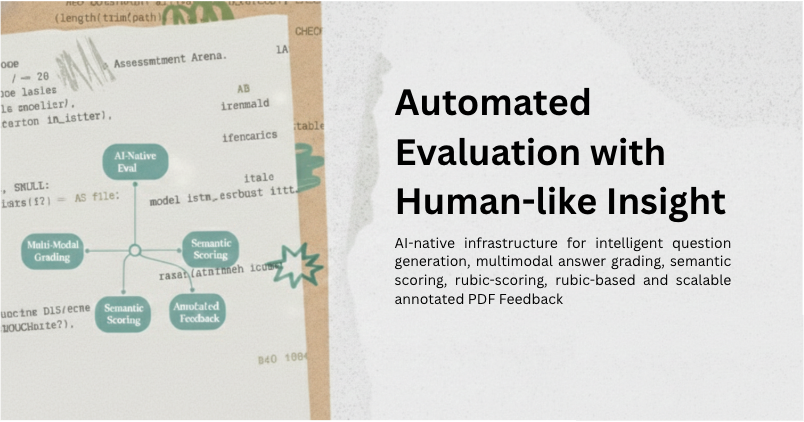
AI-Native Evaluation at Scale
Assessment Arena is an AI-native evaluation infrastructure designed to automate the entire assessment lifecycle: dynamic question generation, multimodal answer evaluation (handwritten, typed, or uploaded PDFs), semantic grading, and human-like annotated feedback—all at production scale.
The Problem: Traditional grading systems are binary—right or wrong. Real education requires nuanced evaluation: understanding partial correctness, recognizing alternative approaches, and providing constructive feedback. Automating this requires both deterministic scoring and generative explanation.
The Solution: A hybrid evaluation engine that separates deterministic scoring (rubric-based, reproducible, auditable) from generative feedback (contextual, supportive, personalized). The system ingests multimodal submissions (PDFs, images, handwriting), extracts text using advanced OCR with spatial awareness, applies semantic scoring logic based on curriculum rubrics, and generates teacher-style annotations overlaid on the original answer document.
Key Innovation - Hybrid Grading: Rubric-driven semantic evaluation that uses curriculum-aligned rubrics to score answers according to predefined criteria. Handwritten submissions are processed with spatial memory, allowing annotations to be placed exactly where the student made a mistake—replicating human grading patterns rather than generating generic feedback.
Production Metrics: Processes 200+ papers per hour, semantic grading with rubric compliance, visual feedback overlays that mimic human annotations, PDF rendering with sub-second latency for cached assessments.
AI Notes Generator
Static PDF Generation for Educational Content
A production-grade pipeline that converts raw curriculum data into structured, visually rich PDF textbooks using multi-layer caching and layout-aware rendering. This system demonstrates how to apply Static Site Generator (SSG) principles to AI-powered content generation.
The Problem: Generating educational content is computationally expensive. LLM token costs multiply when generating the same chapter for thousands of students. Additionally, raw LLM output lacks structure—no proper formatting, page breaks, or academic standards compliance.
The Solution: Cache-First Architecture treating notes as immutable artifacts. Once generated, PDFs are cached and served globally. The first user pays the generation cost; subsequent users get instant delivery from cloud storage at sub-second latency.
Key Innovation - Artifact Caching: Three-stage pipeline with content-addressable hashing. Stage 1 generates curriculum structure (JSON). Stage 2 enriches content with media and formatting. Stage 3 renders to layout-aware HTML and compiles to PDF. Each stage's output is hashed and cached, achieving 85% cache hit rates.
Production Results: 80% cost reduction per PDF, print-quality output compliant with CBSE standards, sub-second delivery for cached content, support for KaTeX/LaTeX mathematical equations.
